THE MAGIC OF DESIGNING BY MAKING REAL (PROTOTYPING!)
Make it real, build it fast, and experience your design from day one of the process.
After some recent discussions about our process I felt it was high time I wrote something about what it means to design by creating prototypes.
We’re product designers, which means we’re in the business of not only creating new things, but more specifically - we take ideas and opportunities and turn them into something real, something tangible, something that has a life of it’s own.
So how do we get past that writers block moment of worrying “is this a good idea?” How do we make progress in the face of trying to imagine how a new creation will look, will function, will behave and interact all at once? And most critically, how do we make sure we don’t commit to time and money to developing the wrong idea in the wrong way or for the wrong reasons?
The answer is to design by creating prototypes in a cycle of ever improving iterations - a continually evolving family tree of artefacts that culminates in a finished product. A product that is often more beautiful, more exciting and more able to survive in the real world than anyone imagined it might be at the start of the process.
Making an idea real through some form of prototype is what allows you to experience the idea. To test it and simulate it. Does it work? Does it fall over? How does it inhabit its environment? How does it make people feel?

Think you know what a prototype is?
This is really important - a prototype is not just the first draft of the finished design. It is something, anything, that you can use to make an idea more real, more tangible as part of the ongoing design process. You need a prototype to bring an idea to life and test it. Test its aesthetics, function, scale, emotional impact, weight, shadows, balance, comfort, strength, range of motion… the list is truly endless, and up to you as part of your creative process.

For example, here are some kinds of prototype we’ve used to progress designs to great effect.
- A sketch (visual) or sketch protoype (physical).
- A faked social media advertisement for the final product.
- Kit-bashing (take an existing product, hack it apart and re-configure into something new).
- A visual mock-up (collage / photoshop / AI...) to ask “What does it look like on a shop shelf”? or "What’s the message that makes me want to buy it?"
- Technic lego + blu tack + rubber bands + card to show movement of a mechanism (or a CAD model!)
- Sketch CAD straight to a 3D render over a photo - this is what it might look like in the end - what do we think?
- Switch to 2D only - work with a graphic designer to explore form as if it were a logo design exercise (hats off to the incredible Jaakko Tuomivaara for past collaborations on many fantastic designs over the years in this way).
- And of course, later in the process there are 3D prints, vacuum casts, code and electronic mockups, all of which we try to do in-house as part of the ongoing iterative design process, leading eventually to versions of pre-production protoypes, used for final product verification and manufacture-ready sign-off.
…see what I mean? It becomes an incredibly wide and eclectic range of techniques and approaches.
Always push the boundaries of what a prototype is. Finding new and better ways to make novel ideas tangible and testable, tailored to each new design challenge, is one of, if not the most important part of a successful design process.

The end result.
Making an idea tangible in this way accelerates the design process and prevents it becoming a boring and linear process with pre-defined outcomes (who needs that!?). Bad features and ideas can be culled. Unforeseen issues can be spotted, played with and improved. Completely new designs, opportunities, interactions and features can (and always do!) emerge from playing, tinkering and experimenting with tangible mockups and prototypes.

Opportunites are discovered. New ideas are created. Development is accelerated. And risk is reduced. It’s the only way to design!
Hope you agree,
Duncan Foster Fitzsimons. Director.
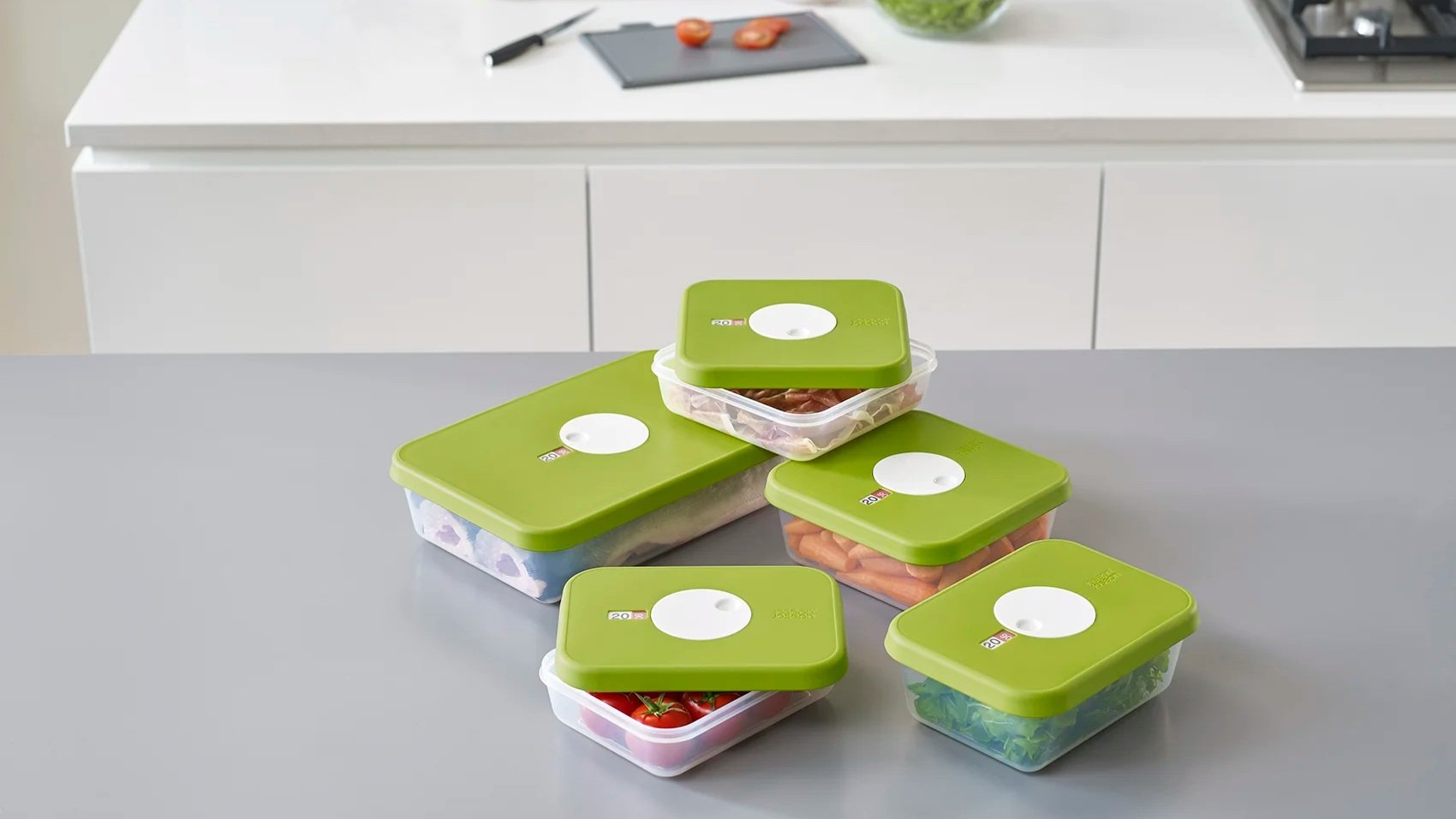
(Take a look at the finished product - Dial Storage for Joseph Joseph here.)